


When you put puff dough in the oven, the water inside turns into steam, which breathes through its greased layers and creates a delicate, flaky structure. On icy bodies across the Solar System, a somewhat similar process—though without butter and under extremely low pressure—may produce landforms in regions of effusive cryovolcanism. In this process, instead of molten rock (magma), a mixture of water, salts, and other substances erupts onto the surface, where it rapidly freezes at low temperatures to form an icy “lava.” A new study experimentally shows that erupted water on icy moons can boil and freeze at the same time, building surprisingly complex structures resembling puff pastry.
On the dwarf planet Pluto and on the moons of Jupiter and Saturn—such as Europa and Enceladus—subsurface oceans of liquid water are thought to occasionally spill onto the surface in a process reminiscent of volcanism on Earth. A team led by Petr Brož (Institute of Geophysics of the Czech Academy of Sciences), together with Vojtěch Patočka (Faculty of Mathematics and Physics, Charles University), in collaboration with Dr. Mark Fox-Powell and Dr. Manish Patel at The Open University, placed a container with 40 litres of water inside the GEORGE vacuum chamber in Milton Keynes, UK, to investigate what might happen during such an outflow of “cold lava.”
The surfaces of these icy worlds typically lack an atmosphere, conditions that can be reproduced in a vacuum chamber. Under low pressure, water becomes unstable and rapidly turns into vapour—in other words, it begins to boil. Importantly, water does not need to be heated to 100 °C to boil; at sufficiently low pressures, boiling occurs at any temperature above the freezing point. As the fast-moving molecules escape as vapour, the remaining liquid cools rapidly and the surface soon starts to freeze. The competition between escaping vapour and the newly forming ice leads to the formation of previously unobserved structures, similar to flaky puff pastry also known as phyllo dough (Fig. 1).
“From earlier, shorter experiments, we already knew that water would keep boiling beneath the ice crust for some time, and that bubbles can occasionally rupture the ice,” explains Petr Brož. “What we did not know—and what we wanted to find out—was how long this cracking would last and how much water would be lost in the process.”
“As vapour escapes, the system continuously loses energy—both through evaporation and through ice sublimation—so one might expect the crust to thicken over time and the water to eventually freeze completely. But we were in for a surprise,” adds Vojtěch Patočka.
The vapour proved powerful enough to lift entire slabs of ice once the crust reached a critical thickness at which bursting bubbles were no longer capable of causing local fractures. This process repeated multiple times, producing a complex layered structure. Each cycle of uplift and refreezing created a new layer—much like the successive layers in puff pastry. In other words, water attempted to escape as vapour while the surface was simultaneously freezing, and this competition produced an unusual, bubble-rich and layered ice.
“In the laboratory, the thickness of the resulting ice reached around ten centimetres. That may not seem like much, but on bodies with lower gravity this bubble-rich ice would be proportionally thicker. On Enceladus, where gravity is about 100 times weaker than on Earth, such layered ice could grow to tens of metres in thickness. This is because hydrostatic pressure increases more slowly with depth, allowing boiling to occur deeper below the surface,” explains Patočka.
These newly observed processes may strongly influence how materials from subsurface oceans—including salts and organic compounds—are deposited on the surfaces of icy moons and other bodies. Understanding whether such highly porous, layered ice exists could also help improve the safety of future spacecraft landings on these exotic worlds. It is not yet clear whether these structures actually exist on icy moons, but this may soon change: two missions, JUICE and Europa Clipper, are on their way to explore these environments using radar capable of probing beneath the surface to find places where this porous ice may be.
This research was supported by the Czech Science Foundation under project 25-15473S.
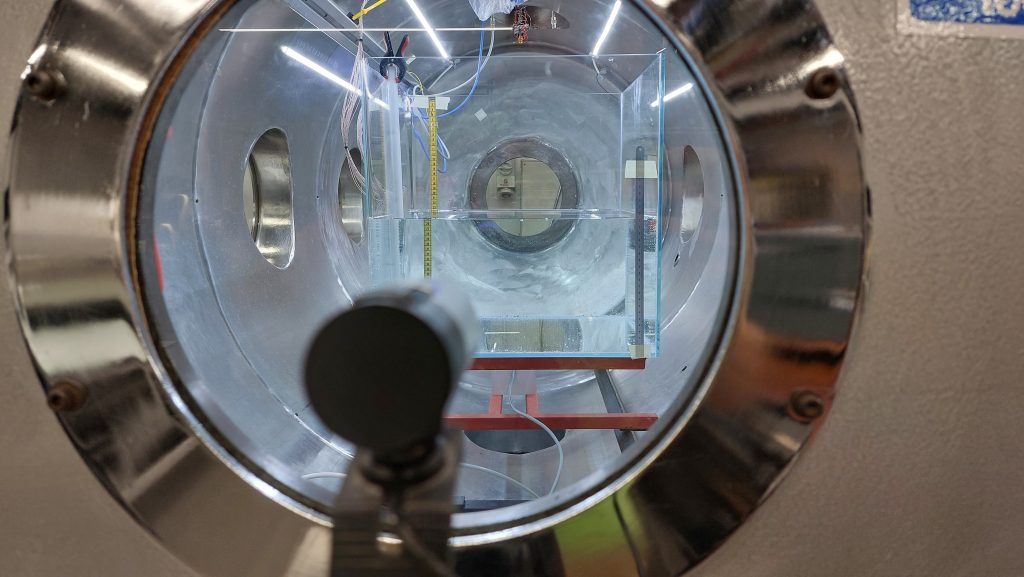
Figure 1: Experimental setup (top) inside the GEORGE vacuum chamber at the Open University (bottom), where scientists simulated near-vacuum conditions and observed how water can simultaneously boil and freeze.
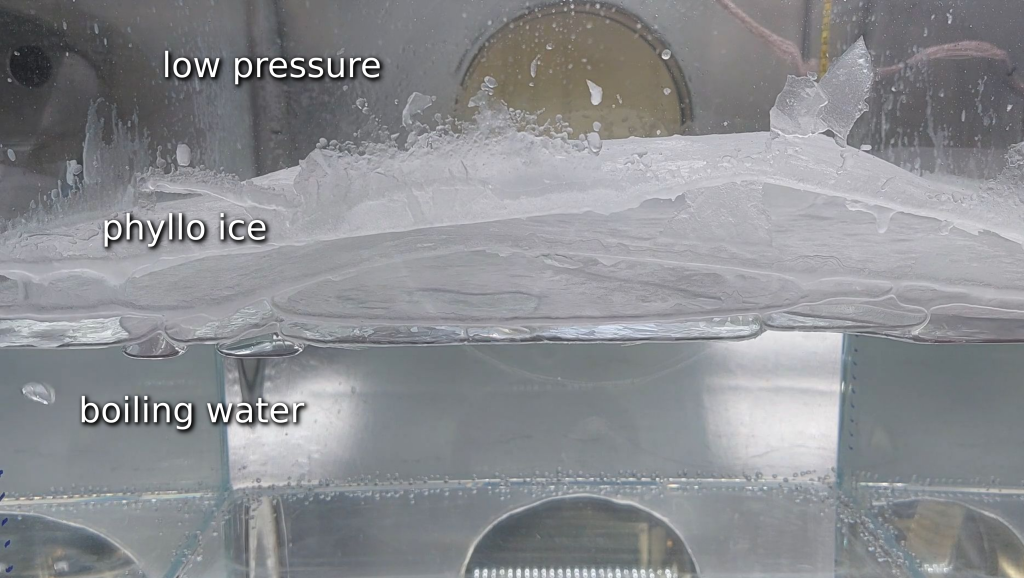
Figure 2: Ice structure resembling puff pastry: thin layers of ice repeatedly lifted by escaping vapour during freezing. The full interplay between vapour and ice can also be seen in the accompanying video.
Video: Footage of the experiments showing the vacuum chamber setup, boiling under low pressure, and the gradual formation of porous, layered ice shaped by the competition between vapour escape and surface freezing.
Link to the study:
https://authors.elsevier.com/sd/article/S0012-821X(26)00182-2
Contact details:
Dr. Vojtěch Patočka
vojtech.patocka@matfyz.cuni.cz
Dr. Petr Brož