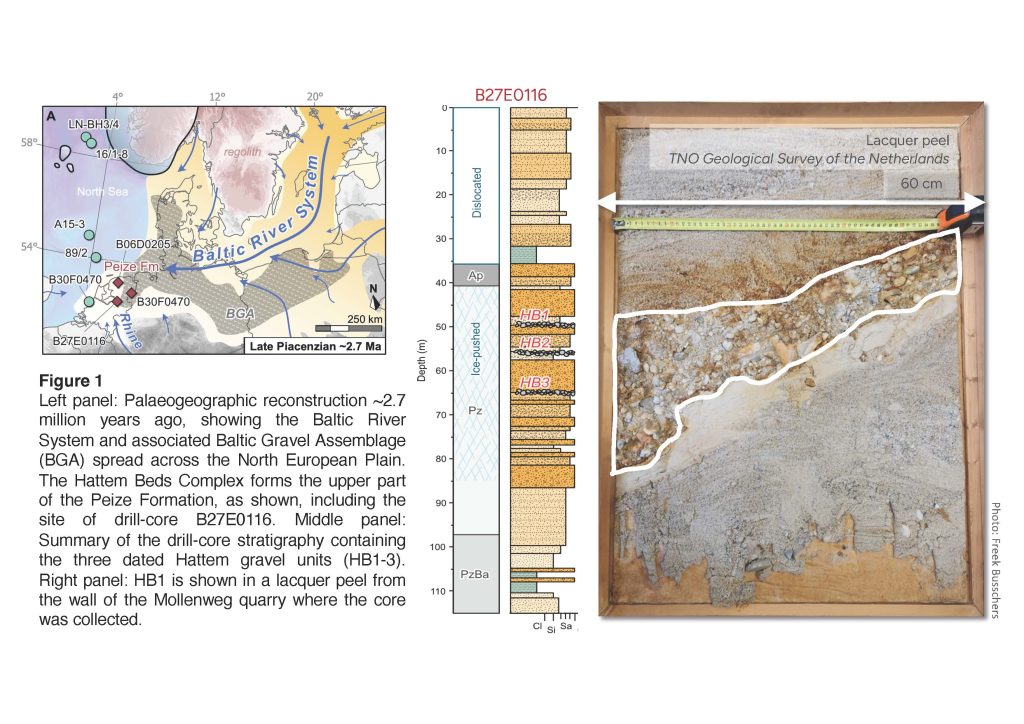

Understanding when ice sheets first developed over the northern continents is essential for attributing ice volume to marine records of global sea-level change. GFÚ researchers, Kaleb Wagner, Lotta Ylä-Mella and John Jansen (Surface Processes & Palaeoclimate), lead a paper published this week in the journal Nature Communications that constrains the first expansions of the Eurasian Ice Sheet at ~ 2.4 million years ago (Ma). This work forms a key part of the PhDs of Kaleb and Lotta and features an international team of researchers from Czechia, Denmark and the USA.
The study resolves a long-standing mismatch between indices of timing of the first Eurasian Ice Sheet expansion in terrestrial and marine records by dating the earliest known glaciogenic sediments in northwest Europe, the Hattem Bed Complex. Burial dating with cosmogenic 26Al-10Be and detrital zircon fingerprinting indicate that the Fennoscandia-sourced Hattem gravels reached the Netherlands by ~ 2.4 Ma, while ages from the overlying Appelscha Formation record a second ice-sheet advance and glacial destruction of the former Baltic River System at ~ 1.7 Ma.
You can read full article here.