


Earthquakes and the resultant landslides can potentially increase the rate of carbon export from mountainous regions by eroding organic carbon stored in hillslope soils and transporting it to rivers. The 2008 Mw7.9 Wenchuan Earthquake generated the largest volume of landslides in recent history, providing a unique opportunity to quantify carbon flux driven by a mega-earthquake.
GFÚ researcher, John Jansen (Surface Processes & Palaeoclimate) is a co-author among a team of Chinese researchers who this week published in Nature Communications the results of an empirical study showing that, thanks to post-event revegetation and large-scale intermontane sediment storage, the Wenchuan Earthquake has boosted carbon mass by ~10% within the Longmenshan Mountain Range 2008–2020.
In effect, landslides act as ‘capacitors’ that regulate carbon storage and discharge from mountain belts through time. The open access article can be accessed here.
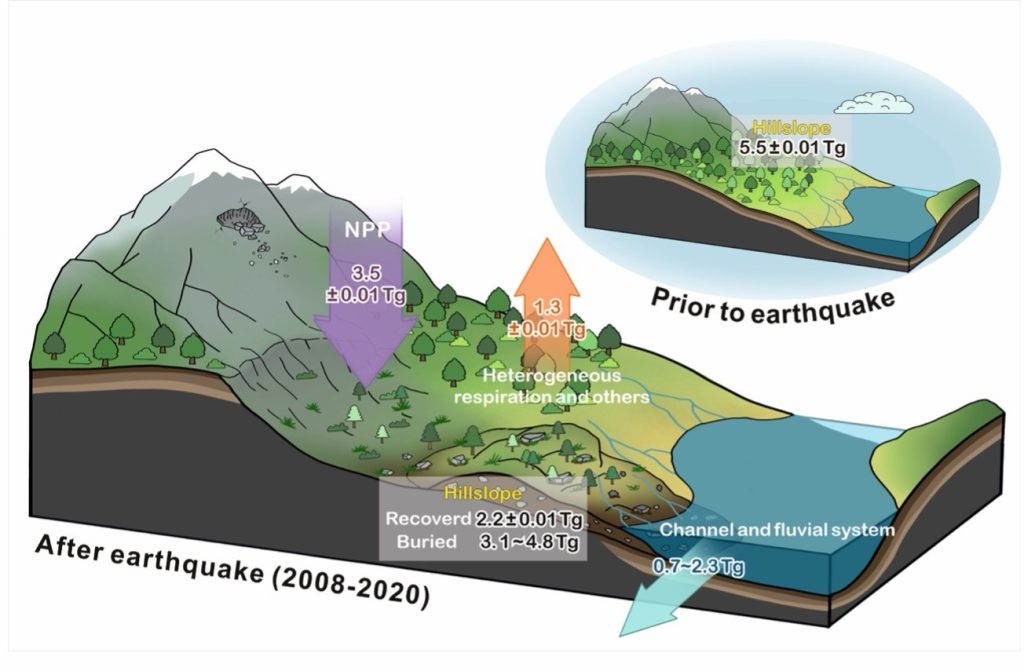
Overview of hillslope OC budget triggered by the 2008 Wenchuan Earthquake. Arrows represent carbon fluxes, and grey boxes indicate hillslope carbon stocks within landslide-affected areas. Numbers denote the accumulated organic carbon (OC) mass associated with these processes from the time of the 2008 Wenchuan Earthquake to 2020.